zju1575
Koch Curve
http://acm.zju.edu.cn/show_problem.php?pid=1575
Time limit: 1 Seconds
Memory limit: 32768K
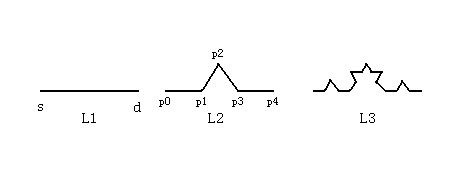
Koch Curve is very common in fractal. It has infinite length. The figure above illustrates the creation of a Koch Curve. A line segment L1 (a->d) is given. It is cut into three equal parts. L2 is obtained by rotating the middle part counter-clockwise to vector s->d. The length satisfies the constraint p0p1 = p1p2 = p2p3 = p3p4. We further process on p0->p1, p1->p2, p2->p3, p3->p4 to obtain L3. We proceed with such iteration to obtain Koch Curve. Since the length is increased by 4/3 each iteration, the length of Koch Curve is infinite. With given s and d, you are to provide the result of the n-th iteration.
Input
There are multiple tests, in each test.
The first line contains an integer n (1 <= n <= 7).
The second line contains four floating numbers sx, sy, dx, dy.
Output
For each test print the vertex in the order from s to d. Keep two digits after decimal point.
Print a blank line after each case.
Sample Input
1
0 0 3 0
1
3 0 0 0
Sample Output
0.00 0.00
1.00 0.00
1.50 0.87
2.00 0.00
3.00 0.00

3.00 0.00
2.00 0.00
1.50 -0.87
1.00 0.00
0.00 0.00
Author: DU, Peng
Problem Source: ZOJ Monthly, April 2003
/*Written by czk*/
#include <iostream>
#include <iomanip>
using namespace std;

void koch(int n, double sx, double sy, double dx, double dy, bool print) {
    if(n < 0) return;
    double x1 = (sx * 2+  dx) / 3;
    double y1 = (sy * 2+  dy) / 3;

    double x2 = ( sx + 2 * dx) / 3;
    double y2 = ( sy + 2 * dy) / 3;

    double xm = x1 + 0.5*(x2-x1) - 1.7320508075688772935274463415059/2*(y2-y1);
    double ym = y1 + 1.7320508075688772935274463415059/2 * (x2 - x1)  + 0.5 * (y2-y1);

    koch(n-1, sx, sy, x1, y1, true);
    koch(n-1, x1, y1, xm, ym, true);
    koch(n-1, xm, ym, x2, y2, true);
    koch(n-1, x2, y2, dx, dy, false);
    if(print)
        cout <<setprecision(2)<< fixed<< dx << " "<< dy << '\n';
}

int main() {
    while(1) {
        int n;
        double sx, sy, dx, dy;
        cin >> n >> sx >> sy >> dx >> dy;
        if(cin.eof())
            break;
        cout <<setprecision(2)<< fixed<< sx << " "<< sy << '\n';
        koch(n, sx, sy, dx, dy, true);
        cout << endl;
    }
}